

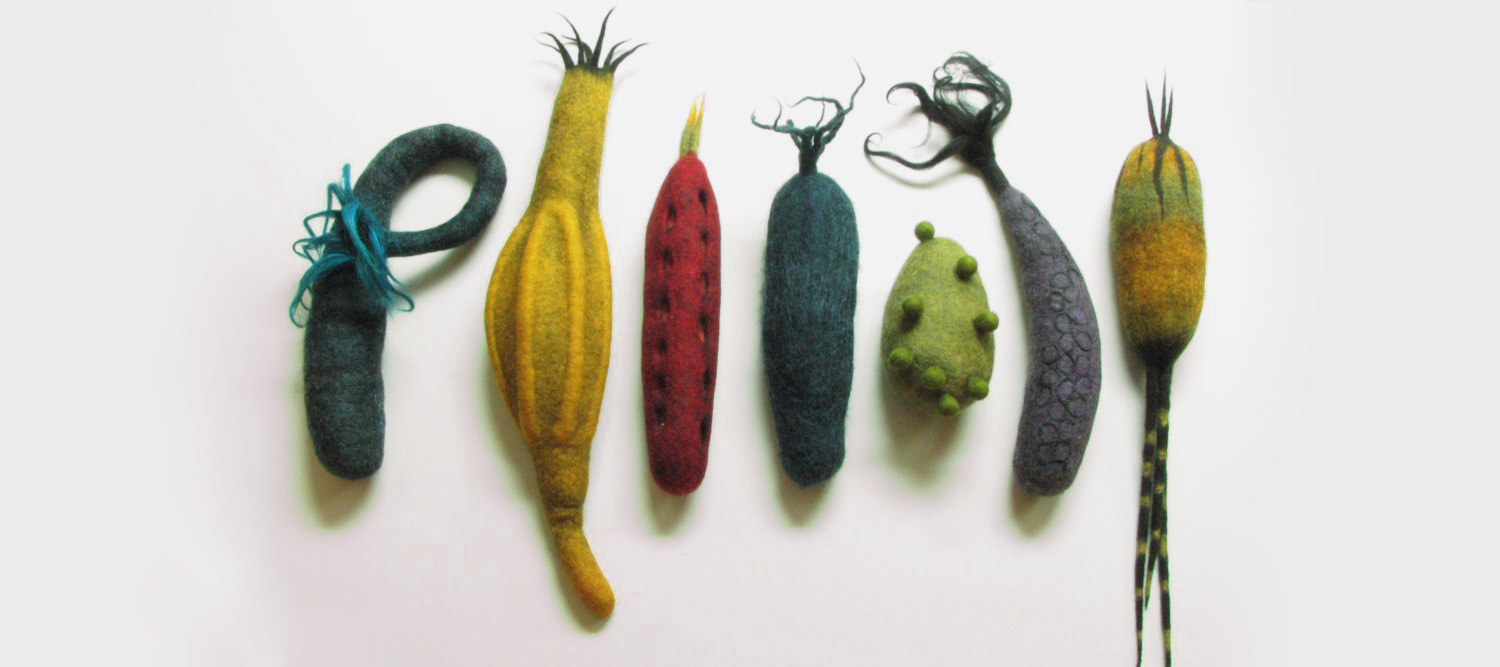
You notice some works right away: Adaptations, Andrea Graham, on display some years ago at the Museo del Tessuto, immediately caught our attention. In the meantime, social media helped us get to know her other works, to see her face and many other small parts of her world.
The next step was to pour ourselves into her website and blog. I wanted to understand where her attraction to those perfect forms lied, how a tuber or a shape vaguely resembling a plant form could ever be so intriguing.
I told myself that it couldn’t only be because they were technically exemplary. It isn’t enough that they are beautiful, decorative and seductive.
I searched further and in the articulate diary that is her blog I found, at one point, a beautiful yet sinister image. It was the enlarged image of a cancer cell. So my mind went straight to the disturbing photographs of Fukushima, to those plants with abnormal fruit and irregularly sized branches and flowers.
Mounting an exhibition provides the great privilege to work side by side, if only briefly, with an artist. It allows the opportunity to get close to them, ask them questions and try to understand what is hidden behind the objects they create.
I don’t know if there is any validity to my impression that the mutating forms created by Andrea Graham, inspired by the adaptive capabilities of the plant world, are a way to exorcise collective anxieties and fears. However, now that I have met her I am convinced of it. I find the value of her work, beyond her perfect technique, her mastery of the art form and the formal completeness of her pieces, lies in this secret way to speak to us all.
If you liked this article maybe you would also enjoy DHG exclusive interviews: Ruth Packham


WRITE A COMMENT